Why we built Grupal: the leads that get lost in the chat
Small businesses rarely lose sales for lack of customers. They lose them between the first message and the close. That is why we built Grupal.
In this article
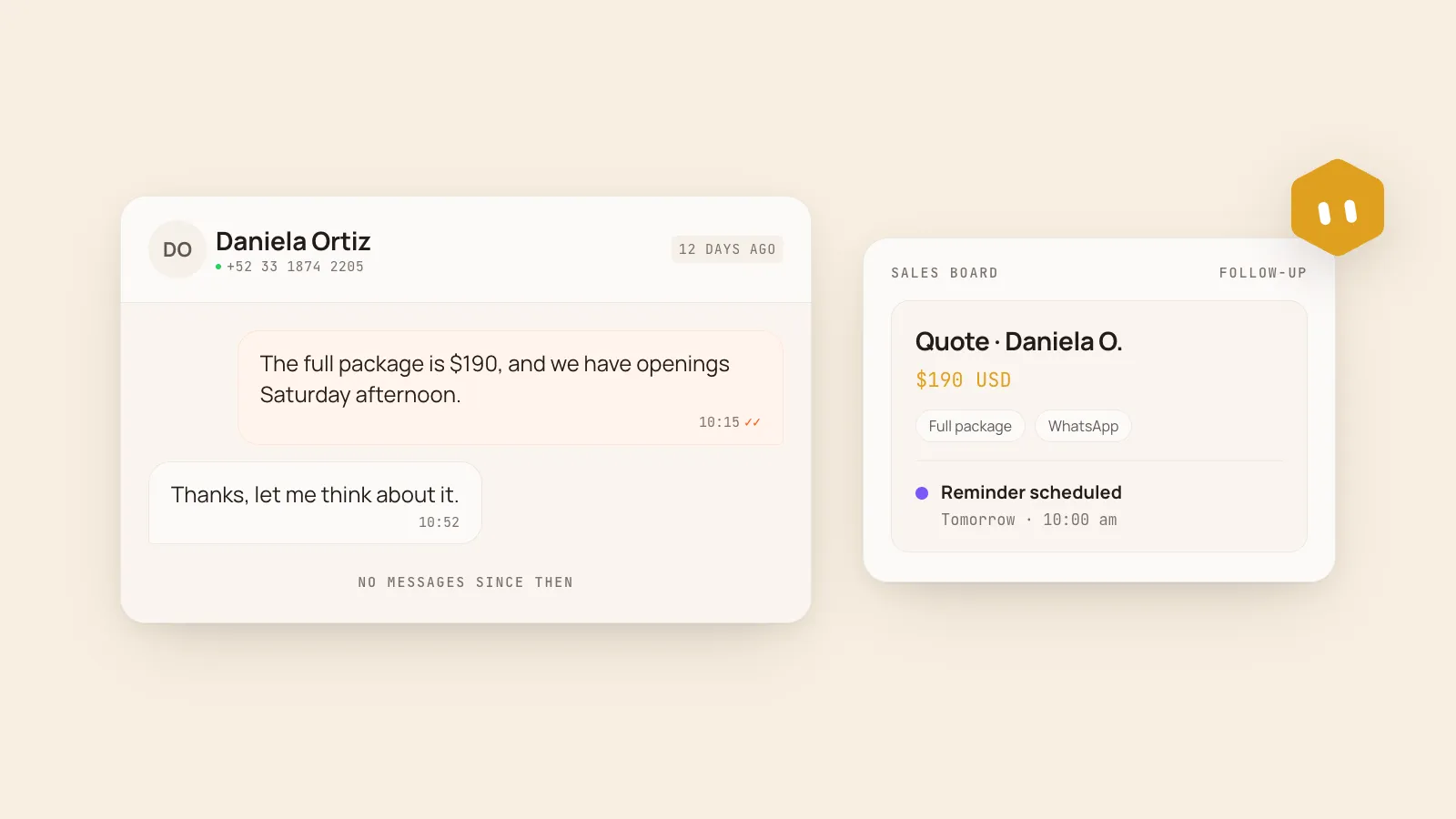
A message comes in at 9:41 pm: someone wants to know what your service costs and whether you have an opening on Saturday. Your team sees it the next morning and replies. The customer says “let me think about it,” and nobody writes back. No one decided to lose that sale. It just happened.
That scene, repeated every day across thousands of businesses, is why we built Grupal. Here is what we saw.
Getting customers is not the problem
Very few businesses are short on messages. They come from an ad, a referral, a Google profile. What almost no one knows is how many of those messages turned into a sale and how many were lost along the way.
In Mexico, the market we built Grupal for first, that path almost always runs through a phone. Microbusinesses make up 95.5% of the country’s businesses, and most of them operate without a computer.1
Meanwhile, WhatsApp reaches 91% of Mexico’s internet users.2 The result is a business that sells over chat and keeps its memory in that same chat: the price that was quoted, the date that was held, the customer who said they would confirm. Leads are not lost for lack of interest. They are lost between the first message and the close.
What happens when no one replies in time
In 2011, a team of researchers published a study in Harvard Business Review that measured how long 2,241 US companies took to respond to a lead that came in online.3 23% never responded. Those that did reply within 30 days took 42 hours on average.
In a second analysis in the same article, covering 1.25 million leads, companies that tried to reach a lead within the first hour were about seven times as likely to qualify it as those that tried an hour later, and more than 60 times as likely as those that waited a day. An earlier study, based on data from six companies, found that calling within 5 minutes instead of 30 made qualifying the lead 21 times more likely.4
These numbers deserve a careful read. The data comes from the US, it is more than ten years old, and it measures whether a lead was reached and qualified, not whether it bought. Still, the studies that have measured speed keep finding the same pattern, and the logic needs no statistics: someone asking for a price at 9:41 pm is rarely asking just one business.
The follow-up nobody does
Replying fast solves half the problem. The other half starts when the customer says they will think about it.
From that point on, the sale depends on someone remembering to write back. Velocify, which analyzed millions of leads across hundreds of companies, found that 93% of the leads that converted were reached by the sixth attempt. In an earlier measurement, half of all leads never got a second attempt.5
It is not a lack of effort. Follow-up lives in one person’s memory and in a thread that slides further down the chat list every day. Without a place that records what was quoted, when and to whom, “let me think about it” turns into silence. And since nobody wrote it down, nobody knows how often it happens.
Hiring more people does not scale with your messages
The obvious fix is to put someone else on the phone. It works for a while, until more messages arrive, or they arrive at 11 pm, or on a Sunday. And the person you hired to sell ends up doing data entry: in Salesforce’s State of Sales survey, sales reps said they spend 70% of their time on tasks other than selling.6
In a small business, that person is often the owner. They reply between customers, check their phone during dinner, and conversations still slip through.
Replying now has a cost, too. Since October 1, 2026, Meta charges for service messages sent through the official WhatsApp API, which had been free since November 2024.7 For businesses on the API, a lead that gets a reply and is then dropped is no longer just a lost sale. It is also money spent with nothing to show for it.
Why we solved it with agents
When we started, we did not want to put a chatbot on top of WhatsApp. A bot that answers FAQs handles the first minute and leaves everything else untouched: the record, the follow-up, the handoff to sales.
So we designed it as a team of agents, each with one job. One replies in the moment with your real prices. Another records the contact. Another opens the deal on your board. Another picks up conversations that went cold, only as many times as you set, and with Meta-approved templates once the 24-hour window has closed.
Today
- The 9 pm message waits until morning
- "Let me think about it" stays in the thread
- The quoted price lives in a chat
- Nobody knows how many leads walked away
With a team of agents
- An instant reply, with your real prices
- Follow-up as many times as you set
- Contact and deal recorded right away
- A person steps in with full context
What we did not want was to take people out of the sale. In a Gartner survey of 5,728 customers, 64% said they would prefer companies not use AI for customer service, and the most common concern was that it would become harder to reach a person.8 That fear makes sense when the bot is a wall. That is why every agent works within clear limits, everything it does is logged, and when a conversation needs judgment, it goes to someone on your team with full context. Agents answer and organize. People close.
None of those sales were lost in a single moment. They slipped away: a reply that came late, a follow-up nobody made, a detail that stayed in the chat. Grupal exists to close that gap, so your team starts every morning with conversations answered, contacts recorded and deals in order, and spends its time on what only a person can do: close. The decisions we made to get there are on our about page.
Notes
-
INEGI, “Estadísticas a propósito del Día de las MiPyMEs”, 2024 Economic Census (reference year 2023), June 25, 2025. ↩
-
Asociación de Internet MX, Study on Internet User Habits in Mexico 2026, as reported by SDP Noticias, May 18, 2026. ↩
-
Oldroyd, McElheran and Elkington, “The Short Life of Online Sales Leads”, Harvard Business Review, March 2011. US companies; measures lead qualification, not closed sales. ↩
-
InsideSales.com and James Oldroyd, Lead Response Management Study, 2007: more than 15,000 leads from six companies. The study notes that it did not measure close rates. ↩
-
Velocify, “The Ultimate Contact Strategy,” with data from the first half of 2012: about 3.5 million leads from more than 400 companies. ↩
-
Salesforce, State of Sales, 6th edition, July 2024: survey of 5,500 sales professionals in 27 countries, including Latin America. ↩
-
Meta, “Pricing for non-template messages”, WhatsApp Business Platform documentation, accessed October 16, 2026. ↩
-
Gartner, survey of 5,728 customers conducted in December 2023, published July 9, 2024. ↩